 Get Second Opinion
 Ask Doctor
 Digital Visiting Card
Imagine going for a routine health check-up and finding out that one of the arteries supplying blood to your heart is blocked. Naturally, the first question which comes to mind is how serious the blockage is and whether you will need surgery. Now, if your doctor suggests angioplasty, you might feel relieved knowing that there is a treatment available which does not require opening your chest.
But here is something you need to understand. Not every heart blockage can be treated with angioplasty. While this procedure has helped many patients restore blood flow to their hearts, there are situations where angioplasty may not be the right choice.
So, can all heart blockages be treated with angioplasty? Well, that depends on several factors. In this blog, we will explore how angioplasty works, which blockages can be treated and when other treatment options become necessary.
Understanding Heart Blockages and Angioplasty
Before we discuss angioplasty for heart blockages, let us understand why blockages develop in the first place.
Our heart continuously pumps blood throughout the body. However, the heart muscle itself also needs a regular supply of oxygen-rich blood, which it receives through the coronary arteries.
Over time, fatty deposits called plaque can accumulate inside these arteries, narrowing the passage through which blood flows.
Now, imagine a water pipe that has become narrow due to deposits accumulating inside it. Naturally, less water can pass through. Something similar happens when coronary arteries become narrowed.
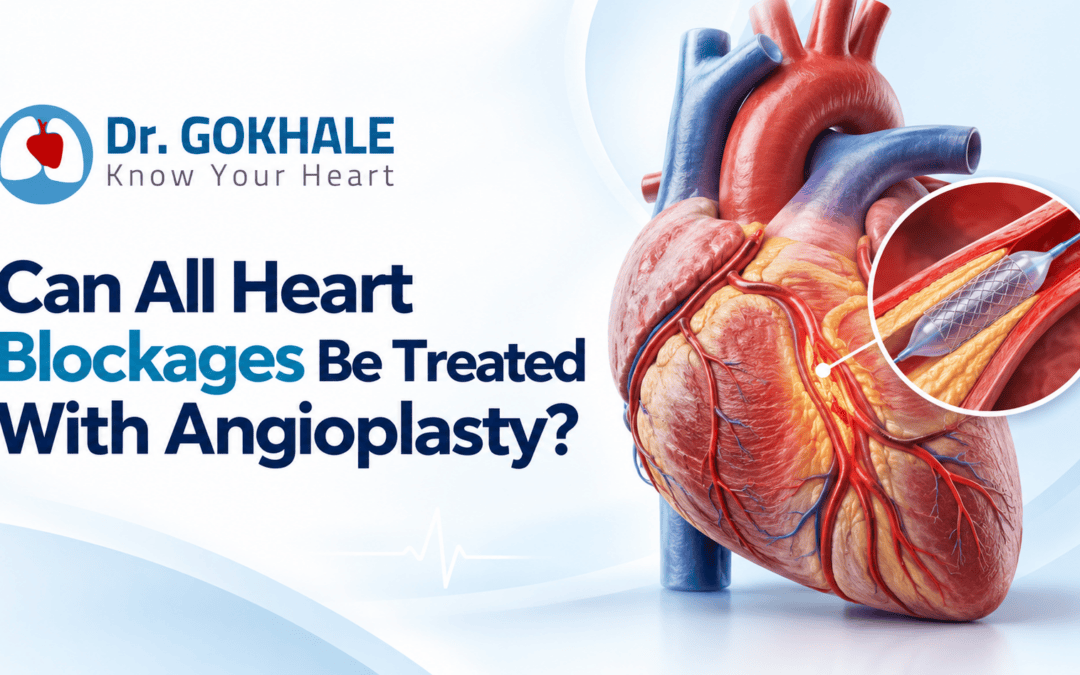
Angioplasty helps widen these narrowed arteries using a small balloon. In most cases, a stent is also placed to help keep the artery open.
Does Every Heart Blockage Need Angioplasty?
Here is where things become interesting.
Suppose two patients are diagnosed with coronary artery disease. One has a single blockage, while the other has multiple blockages affecting different arteries.
Although both patients have the same underlying condition, their treatment requirements may be completely different.
For the first patient, angioplasty might be suitable. However, the second patient may benefit more from coronary artery bypass grafting (CABG).
This is why heart blockage treatment cannot follow the same approach for everyone.
What Percentage of Heart Blockage Requires Angioplasty?
Another common question patients ask is whether a 70% or 80% blockage automatically means they need angioplasty.
Well, not necessarily.
Although a narrowing of 70% or more in a major coronary artery is generally considered significant, the percentage alone does not determine the treatment.
Doctors also consider symptoms, blood flow, heart function and other medical conditions.
Hence, some patients may benefit from medicines, while others may require angioplasty or bypass surgery.
When Is Angioplasty Recommended for Heart Blockage?
Angioplasty may be recommended when a blockage significantly restricts blood flow or causes persistent symptoms despite appropriate medication.
For example, someone experiencing frequent chest pain due to reduced blood supply may benefit from the procedure.
Angioplasty is also an important emergency treatment for certain heart attacks.
However, when blockages are extensive or involve several major arteries, bypass surgery may offer better long-term outcomes.
Therefore, selecting the right coronary artery blockage treatment requires careful medical evaluation.
When Should You Consider Bypass Surgery Instead?
Now, you might be wondering why someone would undergo bypass surgery when angioplasty is less invasive.
The answer is simple. Angioplasty may not provide the best results for every type of coronary artery disease.
For example, patients with complex multivessel blockages, certain left main artery blockages or diabetes alongside extensive coronary disease may benefit more from CABG.
Bypass surgery creates an alternative route for blood to reach the heart muscle, helping overcome the blocked sections.
Choosing the Right Heart Specialist in Hyderabad
When dealing with heart blockages, understanding your treatment options is just as important as receiving treatment itself.
If you are looking for heart blockage treatment in Hyderabad, consulting an experienced cardiac specialist can help you make an informed decision.
Dr. Alla Gopala Krishna Gokhale, a renowned cardiothoracic and heart transplant surgeon at Apollo Hospitals, Jubilee Hills, Hyderabad, specialises in coronary artery bypass grafting, minimally invasive cardiac surgery, robotic heart surgery and complex cardiac procedures.
Patients who have been advised to undergo bypass surgery or require a second opinion can consult Dr. Gokhale to understand their surgical treatment options.
Final Thoughts
So, can all heart blockages treated with angioplasty be managed successfully? The answer depends on the nature of the blockage and the patient’s overall heart health.
While angioplasty is an effective option for many patients, bypass surgery or medical management may sometimes be more appropriate.
If you have been diagnosed with coronary artery disease and are unsure about the next step, seeking expert medical advice can make a significant difference.
Book your consultation or request a second opinion with Dr. Gokhale today.