 Get Second Opinion
 Ask Doctor
 Digital Visiting Card

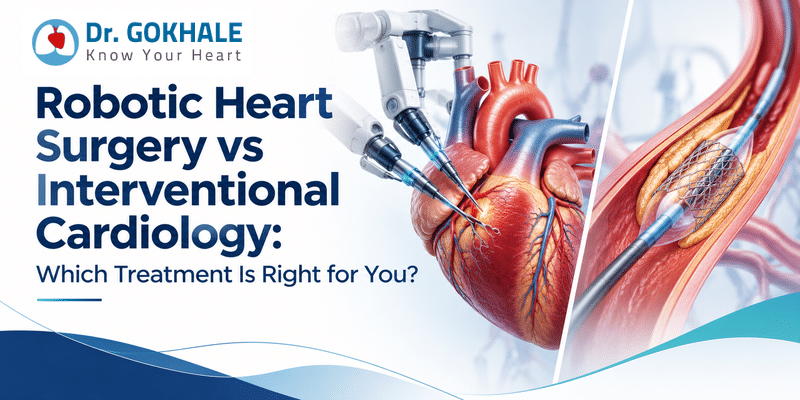
Robotic heart surgery is an operation on the heart done through a few small cuts between the ribs. This procedure is performed using tiny instruments which the heart surgeon controls from a console beside the operating table i.e. the heart surgeon performs the surgeon with his hands by leveraging the robotic hands for high-precision steadier movement inside the chest.
This exception accuracy is made possible by the camera that gives the robotic heart surgeon a magnified 3D and advanced instrument tips that bend and turn in tight spaces, so delicate stitching can be done deep inside the chest without opening it wide. Unlike conventional open heart surgery, robotic heart surgery doesn’t split the breastbone, so there is less pain, no blood loss and a smaller scar which together makes express recovery possible,
Interventional Cardiology
Unlike robotic heart surgery which uses a tiny cut, Interventional cardiology treats the heart from inside the blood vessels, so there is no surgical cut at all in this procedure. An interventional cardiologist passes a catheter, a thin flexible tube, through an artery in the wrist or groin and steers it to the heart while watching live X-ray images.
“Angioplasty where a tiny balloon is inflated inside the narrowed artery to widen it, and a stent, a small mesh tube, is left in place to hold it open is one common procedure that uses similar route”, says popular robotic heart surgeon in Hyderabad, Dr Alla Gopala Krishna Gokhale.
Robotic Heart Surgery vs Interventional Cardiology
Both treatments are aimed at restoring good blood flow through the heart. They do this from opposite ends. Robotic surgery goes in and repairs the heart directly and percutaneous (interventional cardiology) works from inside the vessels.
| Robotic heart surgery | Interventional cardiology | |
| Done by | A cardiac surgeon | An interventional cardiologist |
| Access to the heart | A few small cuts between the ribs | A catheter through an artery in the wrist or groin |
| Anesthesia | General (fully asleep) | Usually local, with sedation |
| Hospital stay | Usually a few days | Often a day or two |
| What it treats | Bypass for blocked arteries, valve repair or replacement, holes in the heart and tumors | Stents for blocked arteries, TAVI, balloon valve procedures, some hole closures |
| Benefit | A lasting repair of complex or structural problems | Fast treatment with the shortest recovery, including in emergencies |
When Is Robotic Heart Surgery Recommended:
Robotic Heart Surgery is a better choice when the heart needs long-lasting repair that can last for years, especially when the blockages are too many or too tricky for stent placement. Some of the common situations where robotic heart surgery is suggested by robotic heart surgeons are:
A leaking mitral valve: A heart surgeon can use robotic heart surgery to repair the valve instead of replacing it. This is highly recommended because repairing the valve spares the patient from potential problems an artificial valve can cause later.
Severe blockage of arteries: Robotic heart surgery is also recommended for bypass surgeries in severe cases of blocked arteries, especially for Diabetes. It is the go-to procedure for repairing long, hardened blockages where stents do not work.
Hole in the heart that the device doesn’t close: When the hole is too large or in an awkward spot, the high-precision robotic heart surgery is the recommended choice.
When Is Interventional Cardiology Recommended:
Interventional treatment is chosen when speed is paramount or when the problem is simple enough for a catheter to fix.
Heart attack: Emergency angioplasty opens the blocked artery and saves heart muscle.
Short, simple blockages: Stents can do the job perfectly.
Narrowed aortic valve cases in older people: TAVI replaces the valve through a thin tube without open surgery.
Patients who may not be the right fit for surgery: Weak lungs, kidney problems or overall poor health make operations risky, and this is where catheter treatment becomes a safer option.
What Decides the Right Treatment for You?
The right treatment depends on your test results and overall health (though test results carry the most weight). Some of the common factors considered are:
- Where the blockages sit, how many, and how long and hard they are
- Which valves are affected – do they leak or are they narrowed?
- How strongly the heart pumps, measured on an echocardiogram (an ultrasound scan of the heart).
- Diabetes, kidney or lung disease, or a past stroke.
- Your age and how well your body can handle general anaesthesia.
- How long the repair needs to last, and how soon you need to be back at work or caring for family.
Weighing all of this is a judgment call, and it’s easier to trust when the person making it isn’t tied to a single technique.
However, the biggest challenge is always finding the right robotic heart surgeon with extensive training, experience, and a successful track record. Fortunately, the right robotic heart surgeon is right here in Hyderabad.
Padma Shri Dr Alla Gopala Krishna Gokhale – Top Robotic Heart Surgeon in Hyderabad
With 16,000 open-heart surgeries on adults and children over the the last 34 years, Dr Gokhale is not just one of India’s most experienced cardiothoracic surgeons, but also one of the most successful, with a 98.4% success rate.
Trusted With the Hardest Cases in India:
Dr Alla Gopala Krishna Gokhale holds the unique distinction of performing:
- India’s first combined heart and kidney transplant
- a heterotopic, or “piggyback”, heart transplant, in which the donor heart is placed alongside the patient’s own heart to share its work
- a heart transplant for a 69-year-old man, the oldest man in India to undergo one
- the first successful heart, lung and double lung transplants in Telangana and Andhra Pradesh, along with the first ventricular assist device implantation there (a ventricular assist device is a mechanical pump that supports a weakened heart)
So, the surgeon weighing a stent against surgery for you has treated heart disease at its most advanced, as well as the everyday bypass and valve problems this guide describes.
Talk to Dr Gokhale Before You Decide
Each option in this guide suits some hearts, and only your angiogram, echocardiogram, and other reports can show which one fits yours. Dr Gokhale can guide you far better once he has seen them. Book an appointment, and he will walk you through every option, explain what suits your heart and why, and help your family decide with confidence.
If you live in or around Hyderabad, book an appointment through our contact page or call us at +91 96030 40506.